{{e.method}}
{{e.title}}
{{e.status}}
- Observed evidence
- {{e.evidence}}
- Interpretation
- {{e.interpretation}}
- Next step
- {{e.next}}
We use cookies to understand how visitors use this site. Analytics stays off unless you accept.
UX Leadership · Research Operations · Experimentation
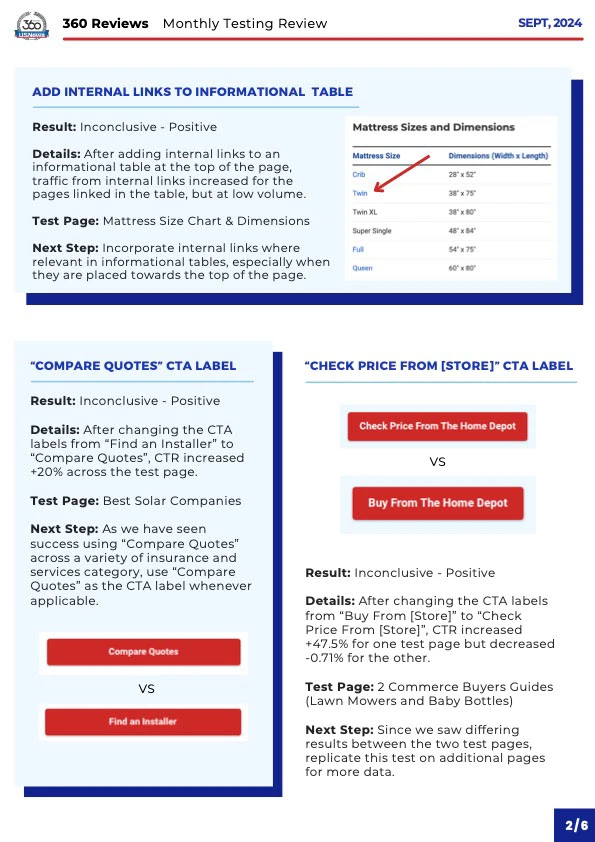
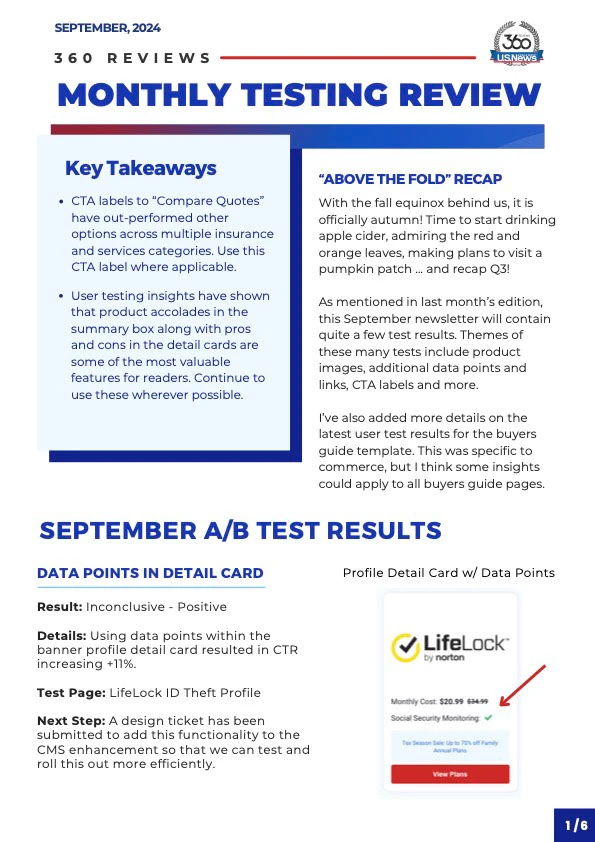
Different teams were running valuable experiments, but the lessons often stayed inside each product vertical. I led a monthly testing practice that brought A/B results, user feedback, design decisions, and next steps into one conversation.
My role: UX/UI Designer and Testing Program Lead
Optimizely · UserTesting.com · Figma · Gemini · Claude
At a glance
The deliverable was a monthly review, but the real design work was the system behind it: deciding what to test, improving the research, connecting quantitative and qualitative evidence, and helping teams act on what we learned.
{{s.body}}
The challenge
Each vertical focused on its own goals, pages, and experiments. That independence helped teams move quickly, but it also created a visibility gap. People did not always know what other groups had tested, which patterns were appearing across products, or whether an idea had already produced positive, negative, or inconclusive evidence somewhere else.
The problem was not a lack of activity. It was a lack of shared context.
{{p.body}}
My thinking
My first instinct could have been to improve individual experiments. Instead, I stepped back and looked at the path the learning took after a test ended. That revealed a larger opportunity.
I was not trying to create another report. I was trying to create a habit of shared learning.
Three moves took the work from “run better tests” to “learn as one organization.”
{{st.label}}
{{st.body}}
The system
The monthly recap was the visible output. The work began much earlier, with a clear question and a research plan.
Research approach
{{m.tag}}
When possible, the strongest recommendation connected behavioral evidence with the reason a design helped, or confused, the user.
Script quality
I wrote and reviewed the testing scripts, then refined them before launch. The goal was not to lead people toward our preferred design. It was to create tasks that felt natural, left room for honest reactions, and helped us distinguish a usability problem from a personal preference.
{{c.body}}
AI note
Gemini helped us pressure-test early script drafts by identifying leading wording, ambiguous instructions, and missing follow-up questions. I reviewed every suggestion and made the final research decision.
Making the learning visible
I created a consistent monthly format so the audience could quickly understand what was tested, what happened, what the evidence meant, and what should happen next. We shared the review across teams and discussed it in a meeting, giving each vertical access to insights that might otherwise have stayed local.
{{a.body}}
The format made uncertainty visible instead of hiding it.
{{liveMessage}}
Representative evidence
The value of the review came from presenting the evidence honestly. A positive signal could lead to a broader test. A negative result could stop an unhelpful direction. An inconclusive result could expose a measurement problem or identify the need for more data.
{{e.method}}
{{e.status}}
Honesty note. These labels preserve the original review’s result language. They should not be rewritten as definitive wins.
AI-assisted, human-led
Gemini and Claude gave us a fast, low-risk way to challenge an early idea. We could ask whether a task sounded leading, whether a design created an obvious point of confusion, or what alternative explanation we might be missing. This helped us improve the material before spending participant time or launching a live experiment.
AI was a critique partner, not a research participant.
Impact
Individual tests produced useful product evidence. The monthly practice changed how that evidence moved through the organization.
{{im.body}}
What was not measured. Program-level conversion or revenue lift was not measured as part of this case study. The documented outcome is a more visible, consistent, and collaborative testing practice.
Reflection
{{l.body}}
{{imp.body}}
The takeaway
By connecting experimentation, user research, design critique, synthesis, and communication, I created a clearer path from isolated evidence to shared product decisions.
Return to the beginning